Regenerative Design Is the New Sustainability: Why Design News Is Shifting Focus
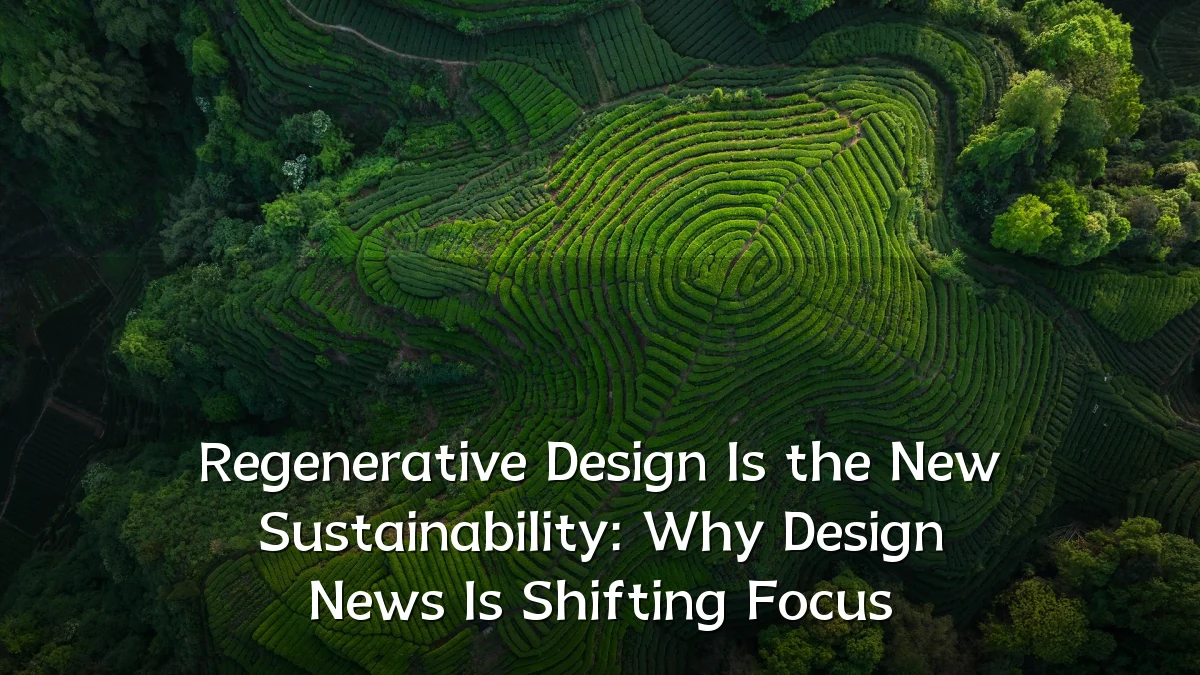
The design news cycle is undergoing a quiet but significant vocabulary shift. “Sustainability” is fast becoming an assumed baseline, outpaced by a more ambitious term: regenerative design. In coverage across architecture, urban planning, and product development, the focus is moving away from simply reducing harm and toward restoring the systems that human activity has degraded. This analysis examines why the news is shifting, what this new framework actually entails, and where it is heading next.
Recent Trends in the Design News Cycle
Recent industry coverage shows a distinct move away from headline-grabbing “green” gadgets and toward systemic, ecological thinking. The current wave of design news is defined less by efficiency metrics and more by restorative capacity.

- Net-Positive Architecture: Buildings are increasingly framed as potential power plants and water purification hubs, rather than just energy consumers striving for net-zero status.
- Carbon-Sequestering Materials: News stories are focusing on bio-based materials—such as mycelium, hempcrete, and mass timber—that actively draw down atmospheric carbon during their life cycle.
- Circularity and Material Passports: Emphasis is growing on designing for disassembly and creating platforms that track a material’s value across multiple use cycles, minimizing waste to near zero.
- Biodiversity as a Design Metric: Urban design news is incorporating concepts like “net-gain” for local species, soil health, and water infiltration, shifting focus from building footprints to ecosystem footprints.
Background: From Net-Zero to Net-Positive
The term “sustainability” originally gained traction as a response to the pollution and resource depletion of the industrial age. In design news, this translated into decades of optimization: reducing energy loads, sourcing recycled inputs, and minimizing water usage. While these baseline tactics remain essential, they are built on an ecological ledger that only seeks to be “less bad.”

The editorial pivot toward regenerative design stems from a growing acknowledgment that net-zero emissions are merely a holding pattern. These strategies prevent things from getting worse but do little to reverse the accumulated ecological damage. Regeneration, by contrast, is the closing of the loop; it leverages design to rebuild topsoil, replenish aquifers, and revitalize natural habitats. Design news is documenting a philosophical shift from “doing less harm” to “leaving the system better than we found it.”
User Concerns: Definitions and Verification
As the term enters the lexicon of design journalism and project briefs, key concerns regarding clarity and authenticity have emerged among professionals and end-users.
- Vague Labeling: Without a rigorous, universal standard, “regenerative” is in danger of becoming a marketing catch-all, replacing “sustainable” as a badge with little substantive meaning.
- Greenwashing Alternatives: Current news often critiques carbon offsets as a “pay-to-pollute” loophole. Adopters of regenerative design must demonstrate on-site, physical restoration rather than purchasing distances credits.
- Performance vs. Affordability: Stakeholders are questioning whether regenerative materials and extreme durability requirements will price out standard residential development, creating a “premium” barrier for mainstream adoption.
- Trade-Offs: A product or building may excel at carbon sequestration but underperform on local water use, or vice versa. News analysis highlights the need for a multi-faceted evaluation rather than a single metric.
Likely Impact on the Built Environment and Product Design
If the news coverage translates into widespread practice, the immediate impact will be seen across the contract and specification chain. Design roles will shift from form-making to systems coordination. The utilization of intermittent renewable energy sources, on-site biological treatment systems, and dynamic facades will be standard practice.
Journalism in this space is increasingly focusing on how new benchmarks will consolidate. Potential impacts include the adoption of standards that assess long-term ecological uplift rather than just immediate operational performance, and a push for designers to engage with supply chains to ensure that sourcing actually contributes to regional ecosystem recovery. This will require a level of cross-disciplinary collaboration—pairing ecologists, hydrologists, and data scientists with architects and product designers—that was previously limited to large-scale infrastructure projects.
What to Watch Next
Observers of this trend should track how the industry navigates implementation challenges. Specific events and dates are difficult to predict, but the following developments are likely to shape the next phase of regenerative design coverage:
- Data Standardization: The emergence of government or industry-level protocols that attempt to validate “regenerative” claims, moving beyond self-reported credits toward sensor-based field verification.
- Policy Drivers: Regulatory frameworks that require biodiversity net gain as a condition of project approval, which would rapidly accelerate the need for measurable restorative interventions.
- Retrofit-First Approaches: A news focus on how existing building stock, not just ground-up construction, can be adapted to contribute regenerative benefits to urban districts.
- The Technology Interface: The application of AI and remote sensing to track ecological health over time, providing the necessary data feedback loops for iterative design improvement.
As design news continues to evolve its editorial lens, the distinction between “sustainable” and “regenerative” is becoming clearer. Sustainability is now accepted as a necessary floor—the operating system of the present. Regeneration, however, is the ambitious compass pointing toward the future. The coverage is shifting because the stakes have shifted; the success of the next generation of design will be judged by its ability to truly heal the environments it inhabits.